EDITOR JOHN M. LECATO SHARES
HIS TRAVELS AND MEMORIES
THROUGH THE PAGES OF "THE BEST FRIEND NEWSLETTER"

Charleston Mayor Joe Riley joins in the celebration of Captain LeCato's
80th birthday at Best Friend Museum on May 8, 1996. The Captain's new tie
matches the festive balloons tied to the "Best Friend." As Director
of the "Best Friend Museum," Captain John LeCato was a familiar sight in
downtown Charleston as he walked to and from the museum. His home on
Gadsden Street was the perfect location for a retired sea captain who never
learned to drive a car because a driver was always furnished to him when he was
on land during his 35 year career in the Merchant Marines. He drove the
"Best Friend" each day, pulling it from the Engine House onto the tracks
in the Best Friend Park, so that children could have their birthday
parties on the train. (photo courtesy CCNRHS
archives)
* May
1997
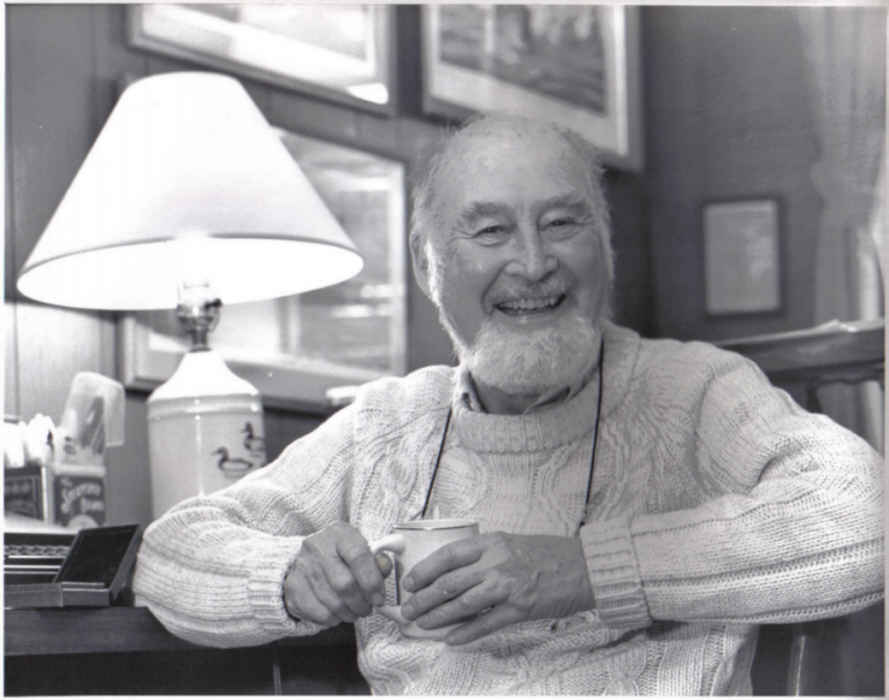
Captain John M. LeCato sits at his desk, surrounded by his books and photos
and railroadiana, collected over a lifetime of fun, family and
friends who shared in his love of the rails and the sea. As editor of "The
Best Friend Newsletter" for almost a quarter of a century, the Captain
entertained us with stories about his travels and his career. A
sample of his news and views, with a bit of humor thrown in, is offered below
for the enjoyment of all.
* photo used with permission of Post &
Courier
"THE MYSTERY LOCOMOTIVE"
Early in October, two rather
bedraggled looking men visited the Best Friend Museum, looking for information
on railroads along the Waccamaw River. I referred them to Tom Fetters'
book, Logging Railroads of South
Carolina.
When I mentioned writing an
article for some rail fan publication, they requested that their names not be
used. One man introduced himself as an archaeologist, the other as a
former resident of the area who some years ago had stumbled on a small
locomotive on the river bank. He claimed to have no knowledge of railroads
and was not sure whether it was steam or diesel. Both said they were
motivated only by curiosity and had a few days spare time on their hands, also
that the only practical means of reaching the spot was by boat. I agreed
that if they were able to rent a suitable boat that I would go along as
navigator and railroad expert to assist in identification of the
engine.
After several days they found a man with a good boat and trailer, also time to take a day off for the expedition. Early one fine Autumn morning, we headed up the highway toward Georgetown. Above Litchfield, we turned left on 707, on down Bay Road to a point where the Waccamaw diverges from the Intracoastal Waterway. Our boat was a handsome little craft with comfortable seats, a windshield and a folding canopy.
Aside from the excitement of the search, it was a beautiful trip. The black water of the river was glassy smooth, trees came down to the water's edge and ibis and other water birds were in constant view. After something more than an hour of travel, our guide asked the operator to reduce speed and swing into a small creek. The fathometer indicated about forty feet of water, with numerous spots of twenty or so feet. The bank was covered with trees and brush and we almost missed the little engine, only a few feet from the water's edge.
After several days they found a man with a good boat and trailer, also time to take a day off for the expedition. Early one fine Autumn morning, we headed up the highway toward Georgetown. Above Litchfield, we turned left on 707, on down Bay Road to a point where the Waccamaw diverges from the Intracoastal Waterway. Our boat was a handsome little craft with comfortable seats, a windshield and a folding canopy.
Aside from the excitement of the search, it was a beautiful trip. The black water of the river was glassy smooth, trees came down to the water's edge and ibis and other water birds were in constant view. After something more than an hour of travel, our guide asked the operator to reduce speed and swing into a small creek. The fathometer indicated about forty feet of water, with numerous spots of twenty or so feet. The bank was covered with trees and brush and we almost missed the little engine, only a few feet from the water's edge.
By pushing the bow into the
muddy bank we could step ashore with dry feet. This activity disturbed a
good sized alligator who slipped off into the stream, also a big snake that
vanished into the undergrowth behind the locomotive. I had a tape
measure and ruler, but was not inclined to get down on my knees for close
inspection.
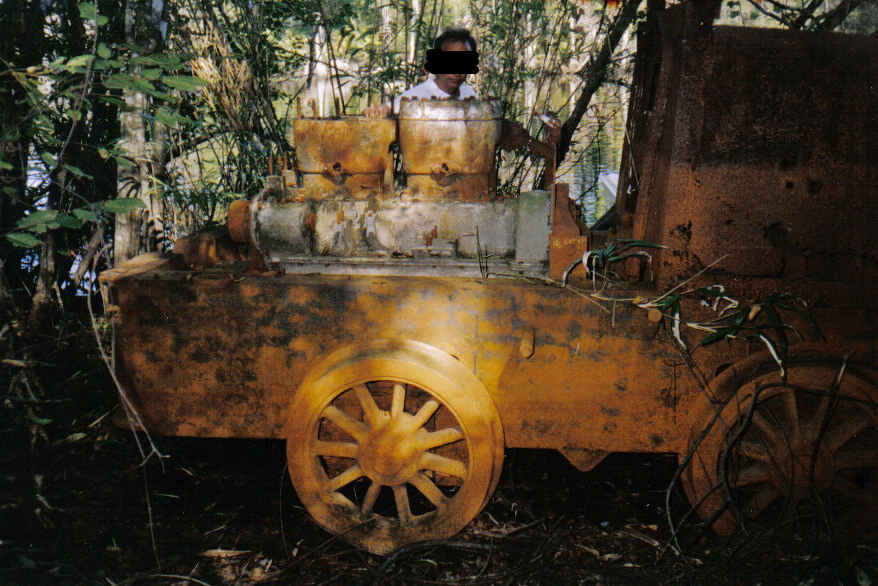
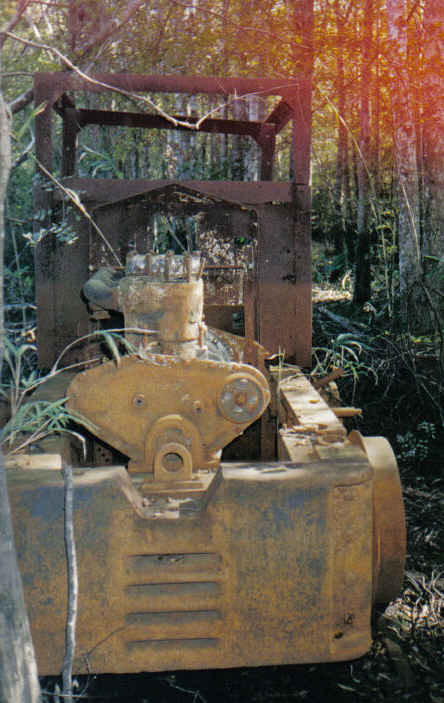
The engine turned out to be a
very early diesel or gasoline powered machine. It was standard gauge, only
eleven feet overall, with a wheel base of about four feet. The four
cylinder engine had been badly vandalized, with one cylinder head missing and
all small parts, such as controls also missing. The hood, cab roof and
fuel tank were gone. Most of the remains were heavy castings. The
pilot beam was slotted for link pin couplers at various heights. The
transmission was joined to the rear axle with a heavy bicycle type chain.
No side rods or other connections to the front wheels were
visible.
The locomotive was sitting on
a pair of light rails, about fifty pounds, I would estimate. Immediately
behind it was a very rusty arch bar truck with no connection. The man who
first reported the engine said that when he had first seen it, about six years
ago there was a hood and smoke stack, also some fittings and a fuel tank in the
cab.
Judging from illustrations in Model Railroader's Diesel Locomotive Cyclopedia, I believe that we have a very early Whitcomb. This company began the production of small gasoline and diesel industrial engines as early as 1906.
Judging from illustrations in Model Railroader's Diesel Locomotive Cyclopedia, I believe that we have a very early Whitcomb. This company began the production of small gasoline and diesel industrial engines as early as 1906.
Now for the mystery...Who
owned or operated the engine and when? Who took the trouble to place it on
the rails on the edge of the river? There is no evidence of any remaining
track or road bed in either direction. The remains of piles for an old
wharf exist a hundred yards or so down stream. Part of an old foundry
still can be found on the opposite bank, but it seems from a period before a
diesel locomotive would have been used. For instance, they produced lead
shot by dropping molten metal from a tower into a tank of water. A
suggestion from one of the men on the trip was that the locomotive and possibly
other equipment may have been moving by barge from one logging site to
another. The owners retrieved the locomotive with their logging equipment,
set it on the bank and decided it was not worth repairing and cannibalized parts
for other engines? The area is said to be rich in submerged artifacts,
maybe someone dragging for salvage, using a fathometer or metal detector found
the engine and set it on the bank?
*
November 1997Follow-up From Fetters
"Mystery Locomotive"
Captain LeCato forwarded photos of
the "mystery locomotive" to fellow rail fan and author of several
railroading books, Tom Fetters. When Chapter member, Mary Lehr, came
across the original newsletter article, she contacted Tom to determine
what became of the mystery. With the Captain gone, there was no
other way to determine the outcome of the mystery. The following is Tom's
response:
I may not be much help this time. I remember the Captain sent the photos, but at the moment they are lost in the mix of things. I will try to find them, but they are not readily accessible as they are in with the logging railroad material.
As to a logging diesel on the side of an island, I was taken along a branch of the Little Pee Dee River some months after the Logging Railroad book came out. We left from Florence and went east to the river at a fellow's home. We went about a mile or two down stream and then hiked on an island where we found some rail and a very small yellow diesel that had been left there when the logging stopped. There was no name on the machine and no means of identifying the owner. While I took pictures, these too are lost in the same pule of material.
With the work going on with the new book on Southern Appalachian loggers, things are oriented to that project.
I did find Jack's letter of June 20, 1998 which may help. He went up the river with some local men who he felt may have been changing their background histories for some reason. They drove up Hwy. 17 from Georgetown for 20 miles, then about 6 miles thrum Burgess and then left on Bay Road which becomes a dirt road or track to Enterprise boat landing. This is where the Intracoastal Waterway diverges to the right from the Waccamaw and the Little Pee Dee River to the left.
The Waccamaw has its own marking system with red beacons with even numbers on the right and green beacons with odd numbers to the left. Number 1 is the point of divergence. This is 14 miles below Conway. (I hope this makes sense to you. I think I understand it, but I did not go this route.)
Check off the markers and stay on the main channel. At Number 3, bear to the right with an Indian Mound to the left on the bank. Beyond this, pass a creek to the right. You pass "Peach Tree", a small settlement. You pass under some power lines at Santee Cut. The Burris Railroad is on the left bank, but not visible. However, there were several shanties and other signs of humans. At Number 5, make a sharp turn to the right. There is an area with some newer houses and a widening of the river called Turkey Lake. There are cars in the driveway so it is near US 701 (probably). You should be able to rent a boat in this area. (The Captain's comment)
Pass #8 and you will see an old foundry on the left. There are pilings of an old wharf on the right at #10. An indentation in the bank here indicates the location of the locomotive. It is visible from the river as you head into the inlet. The river is quite deep and there are lumps rising from the bottom according to the fathometer. These could be boat hulls, railroad cars or logging equipment.
The engine is sitting on two sections of very light rail backed up by the remains of an arch bar truck. A large snake was under the truck and an alligator slid into the water a few feet away. The bow of the boat can be grounded to allow you to step ashore. The land is an impassible swamp back to Highway 544. There are no charts of the waterway markers on the Waccamaw at the local marina supply store. You may have luck at Conway or Georgetown.
I do not think the Captain got back there despite his interest. He had an aversion to snakes, and there were many other reasons that prevented a return trip.
Actually, his description at the end sounds a lot like the diesel that I found, except that this engine was not submerged, but I would have entered the river, perhaps, where the new houses were. There was a white two story new house with a grassy lawn to the river. They had a dog chained up near the house, and I had some concern for the alligators coming up toward the house for a quick meal.
I heard lots of stories about snakes dropping on you from the trees and lurking in the brush, as well as alligator stories. We saw none of this on my trip, but I was not unhappy to be back at the car when it was over.
Let me know if anyone decides to try to follow this route as described in 1998. If I lived there, I would be out this weekend to search.
Post Note
"Mystery Locomotive"
I may not be much help this time. I remember the Captain sent the photos, but at the moment they are lost in the mix of things. I will try to find them, but they are not readily accessible as they are in with the logging railroad material.
As to a logging diesel on the side of an island, I was taken along a branch of the Little Pee Dee River some months after the Logging Railroad book came out. We left from Florence and went east to the river at a fellow's home. We went about a mile or two down stream and then hiked on an island where we found some rail and a very small yellow diesel that had been left there when the logging stopped. There was no name on the machine and no means of identifying the owner. While I took pictures, these too are lost in the same pule of material.
With the work going on with the new book on Southern Appalachian loggers, things are oriented to that project.
I did find Jack's letter of June 20, 1998 which may help. He went up the river with some local men who he felt may have been changing their background histories for some reason. They drove up Hwy. 17 from Georgetown for 20 miles, then about 6 miles thrum Burgess and then left on Bay Road which becomes a dirt road or track to Enterprise boat landing. This is where the Intracoastal Waterway diverges to the right from the Waccamaw and the Little Pee Dee River to the left.
The Waccamaw has its own marking system with red beacons with even numbers on the right and green beacons with odd numbers to the left. Number 1 is the point of divergence. This is 14 miles below Conway. (I hope this makes sense to you. I think I understand it, but I did not go this route.)
Check off the markers and stay on the main channel. At Number 3, bear to the right with an Indian Mound to the left on the bank. Beyond this, pass a creek to the right. You pass "Peach Tree", a small settlement. You pass under some power lines at Santee Cut. The Burris Railroad is on the left bank, but not visible. However, there were several shanties and other signs of humans. At Number 5, make a sharp turn to the right. There is an area with some newer houses and a widening of the river called Turkey Lake. There are cars in the driveway so it is near US 701 (probably). You should be able to rent a boat in this area. (The Captain's comment)
Pass #8 and you will see an old foundry on the left. There are pilings of an old wharf on the right at #10. An indentation in the bank here indicates the location of the locomotive. It is visible from the river as you head into the inlet. The river is quite deep and there are lumps rising from the bottom according to the fathometer. These could be boat hulls, railroad cars or logging equipment.
The engine is sitting on two sections of very light rail backed up by the remains of an arch bar truck. A large snake was under the truck and an alligator slid into the water a few feet away. The bow of the boat can be grounded to allow you to step ashore. The land is an impassible swamp back to Highway 544. There are no charts of the waterway markers on the Waccamaw at the local marina supply store. You may have luck at Conway or Georgetown.
I do not think the Captain got back there despite his interest. He had an aversion to snakes, and there were many other reasons that prevented a return trip.
Actually, his description at the end sounds a lot like the diesel that I found, except that this engine was not submerged, but I would have entered the river, perhaps, where the new houses were. There was a white two story new house with a grassy lawn to the river. They had a dog chained up near the house, and I had some concern for the alligators coming up toward the house for a quick meal.
I heard lots of stories about snakes dropping on you from the trees and lurking in the brush, as well as alligator stories. We saw none of this on my trip, but I was not unhappy to be back at the car when it was over.
Let me know if anyone decides to try to follow this route as described in 1998. If I lived there, I would be out this weekend to search.
* August
2004
Post Note
"Mystery Locomotive"
After receiving the detailed letter
from Tom about what to expect on a week-end outing on the Waccamaw Swamp, we
unpacked out picnic baskets and looked through the papers for a good movie to go
to instead. The challenge is out there from the Charleston Chapter for
someone to "Wade the Waccamaw" to see what hidden treasures lie in the
waters. Please keep us informed.
* Charleston Chapter - bfoc1830@yahoo.com April
2005
Additional Notes to Assist in Locating
Locomotive
Directions: Go up
17 through Litchfield. Left on 707. Thru Burgess. Left on Bay
Road, pass Golf Course, continue on dirt road to Enterprise Boat Ramp.
Ramp is on Intercoastal which bears to right. Waccamaw and Peedee bear to
left, with Peedee turning to left. Waccamaw day marks start at #1.
Pass under power lines at Santee Cut. Burris RR on left bank, not visible
from river. Pass shanty on left bank at #5 make sharp turn to your
right. Pass settlement with new house and remains of foundry.
Continue to #10. Enter Branch to your left. Pass area of rotten
pilings apparently remains of wharf.
Description of Engine: Engine is sitting on bank, partly screened by branches but visible from water. Put bow aground opposite engine and you can step ashore. Be alert for snakes, gators and swamp bears. Engine is estimated to be about 100 yards above pilings, on your right as your proceed upstream.
Description of 0-4-0, diesel four cylinder, one cylinder head missing, along with controls and small fittings, Drive is through transmission and heavy bicycle type chain to rear axle. No visible connection to front axle and no evidence that side rods were fitted.
Gauge is 4' - 81/2'. Body is 11' overall. Wheel base approx. 4'. Cast spoked wheels, approx 221/2" dia. Link pin couplers missing. Four slots in front casting to receive links at various heights.
Person who had seen engine about five years ago stated that it had hood that opened by tilting forward and smoke stack. Cab roof and windows missing. Badly deteriorated arch bar truck sitting behind engine but not connected. Engine sitting on river bank on short sections of light rail, est. 50 pound.
Only legible markings on castings: Bearings for hand crank on front, 10560 and 10561, top of transmission housing, 6993 GDW (barely legible).
Questions: How did engine get in present place? Was it being carried on barge which sank or capsized? Was it retrieved and placed on bank with plans for future reuse? No evidence of tracks in either direction, engine must have come from river. Mud inside cylinders with missing head, was this from recent floods? If engine sank in good condition, would mud be inside engine? NRHS News states that first small diesels produced by Whitcomb, 1906, Does this date from then?
Description of Engine: Engine is sitting on bank, partly screened by branches but visible from water. Put bow aground opposite engine and you can step ashore. Be alert for snakes, gators and swamp bears. Engine is estimated to be about 100 yards above pilings, on your right as your proceed upstream.
Description of 0-4-0, diesel four cylinder, one cylinder head missing, along with controls and small fittings, Drive is through transmission and heavy bicycle type chain to rear axle. No visible connection to front axle and no evidence that side rods were fitted.
Gauge is 4' - 81/2'. Body is 11' overall. Wheel base approx. 4'. Cast spoked wheels, approx 221/2" dia. Link pin couplers missing. Four slots in front casting to receive links at various heights.
Person who had seen engine about five years ago stated that it had hood that opened by tilting forward and smoke stack. Cab roof and windows missing. Badly deteriorated arch bar truck sitting behind engine but not connected. Engine sitting on river bank on short sections of light rail, est. 50 pound.
Only legible markings on castings: Bearings for hand crank on front, 10560 and 10561, top of transmission housing, 6993 GDW (barely legible).
Questions: How did engine get in present place? Was it being carried on barge which sank or capsized? Was it retrieved and placed on bank with plans for future reuse? No evidence of tracks in either direction, engine must have come from river. Mud inside cylinders with missing head, was this from recent floods? If engine sank in good condition, would mud be inside engine? NRHS News states that first small diesels produced by Whitcomb, 1906, Does this date from then?
* November
1997
Newly Found Pictures
of
"Mystery Locomotive"
Newly Found Pictures
of
"Mystery Locomotive"
Thanks again
to the generosity of the Captain's wife, we have have been given these
photographs of the "Mystery Locomotive". As with many of the
treasures left behind by the Captain, these photos were among piles and
piles of what would at first appear to be "stuff" ready for the
dumpster. Maurine LeCato has been so kind to allow us to rummage
through the Captain's maps, photos, model trains, slides, books,
videos, etc. and she has allowed us first choice on those items that
were of interest.
We have obscured the face of the gentleman examining the whitcomb engine in the first photo. Maybe someday he will come across this website and will contact us to discuss this trip. We would love to hear from him.
We have obscured the face of the gentleman examining the whitcomb engine in the first photo. Maybe someday he will come across this website and will contact us to discuss this trip. We would love to hear from him.
 |
 |
*
July
2005
Bazaar and Imaginative
Railroading
Dr. Ken Sexton, PhD. who teaches photo
journalism at Morehead College in Kentucky has sent us some interesting
photographs. Apparently he feels that his students can benefit by coping
old shots of the Hampton and Branchville and other Charleston Chapter
restoration work. One photo was of a weed burner whose thermal effect is
provided by an aircraft jet engine mounted on the head
end.
In our seventy plus years of train watching, it has been our impression that the shorter the line and the more impoverished the company, the more bizarre and imaginative both the maintenance of equipment and signaling practices tends to be. Hence, it was a surprise to note that the jet fired weed burner was lettered CSX.
The Rockton and Rion protects its single grade crossing by dropping a flagman from the head end and when the train has crossed, picking him up on the hind end before proceeding.
Even more unorthodox is the practice of the Queen Anne tourist line in rural Delaware. Their flagman is mounted on a motor cycle and he speeds ahead of the train from crossing to crossing. Fortunately, the highway closely parallels the track. This seemingly wasteful practice dates from the time when rails predated paved roads by several generations and all of the cement, stone and road building equipment had to be brought by train. It was a shame to see such little lines as the Maryland, Delaware and Virginia and the Delaware Coast Line working so industriously to bring about their own destruction.
In our seventy plus years of train watching, it has been our impression that the shorter the line and the more impoverished the company, the more bizarre and imaginative both the maintenance of equipment and signaling practices tends to be. Hence, it was a surprise to note that the jet fired weed burner was lettered CSX.
The Rockton and Rion protects its single grade crossing by dropping a flagman from the head end and when the train has crossed, picking him up on the hind end before proceeding.
Even more unorthodox is the practice of the Queen Anne tourist line in rural Delaware. Their flagman is mounted on a motor cycle and he speeds ahead of the train from crossing to crossing. Fortunately, the highway closely parallels the track. This seemingly wasteful practice dates from the time when rails predated paved roads by several generations and all of the cement, stone and road building equipment had to be brought by train. It was a shame to see such little lines as the Maryland, Delaware and Virginia and the Delaware Coast Line working so industriously to bring about their own destruction.
* April
2001
Fire in Baltimore Tunnel
A recent news article about a
tunnel fire in Baltimore caused me to put together a short account of the
history of the area. For clarity, I am shifting into the first person for
the rest of this piece.
I was raised on a family farm, about twelve miles west of Baltimore and about a quarter mile from the B&O tracks to Washington. These separated from the original old line through Elicott City, passing over a monumental stone arched bridge at Relay.
Our regular means of communication with the city, aside from Grandpap's produce wagon to the markets was by the B&O local trains, or as they were called, "Accommodations," which ran with reasonable frequency in morning and evening hours, generally terminating and originating in Camden Station, now known for the Camden Yards' Baseball Park, home of the Orioles.
The underground portion of the B&O was known as the Belt Line and consisted of ten tunnels, with open spaces between. The most notable section, presumably the site of the recent fire, ran from just south of Camden Station to Waverly Tower in the northeast past of the city. In 1985, this section, some three and three quarter miles was electrified. This operation was complicated by the fact that there was a difference in elevation of 150 feet, giving a ruling grade of 1.5 percent. It was this section that was electrified in 1895. At first power was collected from an overhead rail, but this proved unsatisfactory and from then on an outside third rail was installed. The first locomotives, Numbers 1, 2 and 3 were constructed by General Electric Company, two section coupled 0-4-0 and 0-4-0, 625 volts, weight 196,000 lbs. tractive power 49,000 lbs.
Because of the grade, electric were needed only on the east bound trains West bound, locomotive and cars simply drifted down grade without filling the tunnel with smoke. The electrics were used with both passenger and freight and were capable of pulling a 1200 ton freight up the grade without difficulty. The electric was coupled to the head end of the main line locomotive, then released in a rather spectacular maneuver. As the train neared the end of the electrified section, the motor cut off on the fly, raced ahead and took shelter in a special siding between the main line tracks while the steam locomotive pulled the train on its way. Once the track was clear, the electric went back to Camden Yards to await its next assignment.
Succeeding electrics were built with increased power, the last bing numbers 17 and 18 in 1927, 242,000 lbs. weight and tractive power of 60,5000 lbs. The last electric was replaced in 1942. One of these engines is preserved at the B&O Museum in Baltimore. (Some data above was taken from B&O Power by Larry Sagle and Alvin Staufer)
I was raised on a family farm, about twelve miles west of Baltimore and about a quarter mile from the B&O tracks to Washington. These separated from the original old line through Elicott City, passing over a monumental stone arched bridge at Relay.
Our regular means of communication with the city, aside from Grandpap's produce wagon to the markets was by the B&O local trains, or as they were called, "Accommodations," which ran with reasonable frequency in morning and evening hours, generally terminating and originating in Camden Station, now known for the Camden Yards' Baseball Park, home of the Orioles.
The underground portion of the B&O was known as the Belt Line and consisted of ten tunnels, with open spaces between. The most notable section, presumably the site of the recent fire, ran from just south of Camden Station to Waverly Tower in the northeast past of the city. In 1985, this section, some three and three quarter miles was electrified. This operation was complicated by the fact that there was a difference in elevation of 150 feet, giving a ruling grade of 1.5 percent. It was this section that was electrified in 1895. At first power was collected from an overhead rail, but this proved unsatisfactory and from then on an outside third rail was installed. The first locomotives, Numbers 1, 2 and 3 were constructed by General Electric Company, two section coupled 0-4-0 and 0-4-0, 625 volts, weight 196,000 lbs. tractive power 49,000 lbs.
Because of the grade, electric were needed only on the east bound trains West bound, locomotive and cars simply drifted down grade without filling the tunnel with smoke. The electrics were used with both passenger and freight and were capable of pulling a 1200 ton freight up the grade without difficulty. The electric was coupled to the head end of the main line locomotive, then released in a rather spectacular maneuver. As the train neared the end of the electrified section, the motor cut off on the fly, raced ahead and took shelter in a special siding between the main line tracks while the steam locomotive pulled the train on its way. Once the track was clear, the electric went back to Camden Yards to await its next assignment.
Succeeding electrics were built with increased power, the last bing numbers 17 and 18 in 1927, 242,000 lbs. weight and tractive power of 60,5000 lbs. The last electric was replaced in 1942. One of these engines is preserved at the B&O Museum in Baltimore. (Some data above was taken from B&O Power by Larry Sagle and Alvin Staufer)
* August
2001
Mr. and Mrs.
Editor
For anyone who is waiting with
baited breath for the October 2001 issue of the Best Friend Newsletter, we are
sorry. Mrs. Editor had a bad fall in the street, broke two bones in her
wrist and loosened three front teeth. Consequently, time that should have
been devoted to gathering news items and checking on chapter affairs has gone to
cooking, shopping, laundry and dish washing. Anyone who has sailed on
merchant ships knows there is a crew member with the rating, "Second Cook and
Baker." Ashore that rating includes window washing, cleaning cat litter
pans and trips to Harris Teeter and Piggley Wiggley.
* November
2001
French Railroad
Museum
The Post and Courier on
March 3rd gave a good account of Le Musee Francaise du Chemin de Fer, located in
Mulhouse, in Alsace in Eastern France. The big dome Hass offers a panorama
of railroading, starting with the 1826 locomotive that pulled the first
French train., that predates the Best Friend by four years. It
pulled open sided cars and was noted for spewing cinders on frilly hats and silk
gowns. The museum also displays a series of deluxe coaches from such
trains as the Orient Express and South Africa's Blue
Train.
Among the more modern locomotives is a Baldwin which was among the many engines the US supplied to rebuild French Railroads after WWII. I particularly remember riding behind and photographing the big 141 class delivered by Baldwin, Alco and Montreal. They looked and sounded like typical American motive power of the time, lacking only a headlight, bell and "cow catcher."
It was a real thrill to sit out along the tracks with a bottle of wine and a long French sandwich and watch for the train to come along. The museum also has a world famous collection of vintage autos, Rolls Royce, Ferraris, Bugattis, many of which belonged to famous people and even royalty.
Anyone for France this summer?
Among the more modern locomotives is a Baldwin which was among the many engines the US supplied to rebuild French Railroads after WWII. I particularly remember riding behind and photographing the big 141 class delivered by Baldwin, Alco and Montreal. They looked and sounded like typical American motive power of the time, lacking only a headlight, bell and "cow catcher."
It was a real thrill to sit out along the tracks with a bottle of wine and a long French sandwich and watch for the train to come along. The museum also has a world famous collection of vintage autos, Rolls Royce, Ferraris, Bugattis, many of which belonged to famous people and even royalty.
Anyone for France this summer?
* March
2002
Crescent Limited '84
29 May - 5 June 1984
Our New Orleans holiday started out
auspiciously when AMTRAK Number 88, The Silver Meteor, was announced on time at
the North Charleston station. We went out in the hot, moist night and
walked down a long line of cars to an open door where an elderly gentleman took
our bags and pointed out our roomettes. Everything was delightfully cool.
the upholstery and paint looked clean and fresh and, after explaining the
workings of the berths, our attendant vanished. A small card on the window
shade told us his name was Sodom. In a minute he was back and presented
each of us with a packet of handsome tan stationary, a ball point pen and a
wicker basket containing wine, cheese and other snacks. The ride to
Washington was smooth and uneventful, but when I raised the shade in Alexandria
the platforms were wet and ominous black clouds hung over the
town.
A nagging worry since we bagan planning the trip had been how to dispose of our luggage during the day in Washington between trains. Maurine was convinced, based upon past experience, that there would not be a checkroom or available lockers. We were delighted to find two large, unclaimed lockers. right at the gate. The six quarters required for the keys seemed a worthwhile investment. That problem behind us we walked outside for a brief conference. We decided we could make it to the Washington Hyatt for breakfast. With breakfast under our belts we took another weather check - pouring. Deciding that the price of breakfast entitled us to one of the hotel's free papers and a seat in the lobby, we sat and read and watched the incoming guests. When several appeared without leaving wet spots on the carpet, we sat out for the Smithsonian complex. Two martinis and a roast beef and fried chicken buffet lunch at the Smithsonian Associates dining room saw us well into the afternoon. Another weather check - pouring. We prowled through the Natural History Museum, saw the typical kitchen showing the results if all the offspring of one pair of cockroaches survived and multiplied for a year, also the Hope diamond and more than enough assorted bones, beaks and pelts.
Roanoke Chapter's portion of the Crescent was to be ready for boarding at 4:30 and Maurine and I arrived at the station only moderately damp at the time. After a bit of enquiry an AMTRAK representative pointed out an employees only door and we went through. Several tuscan red cars were sitting on an upper level track near the Metroliners. White coated attendants stood by the open doors and we were soon installed in bedroom No. 1 on the Pocahontas. I would like to have gone out and examined and photographed the equipment but the rain resumed with renewed vigor. I soon found out that we had four cars, as advertised, the smooth side 12 bedroom Pocahontas, the ten roomette, six bedroom Yadkin River, a stainless steel car rebuilt after derailment of the Southern Crescent. Both sleeping cars had the porter's roomette replaced by a shower bath. Also in the consist was the 12 seat diner - crew dormitory car, Carol W. Jensen and the ex City of New Orleans round end observation lounge, Mardi Gras.
Our crew consisted or eight members, all volunteers from Roanoke. Carl Jensen seemed to be in overall charge, his lovely wife, Carol, presided over the diner bearing her name, assisted by two other ladies. Food was prepared fresh by the pastry chef of the Greenbrier Hotel and one of the two lounge car stewards was a Norfolk Southern freight brakeman on holiday. There was also a rather grimy looking man of all work who kept poking into electrical panels and checking for leaking pipes. After the second day, we found out that he was Sid Bailey, a Virginia oil dealer who owned the Pocahontas. The other cars belonged to Roanoke Chapter, NRHS.
The AMTRAK portion of the Crescent arrived from New York and a Washington terminal switcher soon had us coupled to the hind end. Meanwhile Sid Jensen went through the train, greeting everyone and arranging seatings fro dinner. He was dressed for the occasion in a navy blazer so new that I had to remind him that he was still wearing the price tag, Minnie Pearl fashion. In the diner, Carol seated us and presented each lady with a corsage and offered menus. The first dinner, typical of all, included fruit cup spiced with a liqueur, fruit juice and chicken soup. This course was followed by a choice of cole slaw or tossed salad, roast beef , baked ham or deviled crab and several vegetables. Desserts were a fresh peach tart, ice cream with strawberries or cheese and crackers. No liquoe was available, but wine came with dinner and brown bagging was prevalent in the lounge which came with mixers, soft drinks, tea and coffee from seven in the morning until midnight. In mid afternoon and after dinner, the chef came back with silver trays of coolies or slices of cake. Nuts, cheese and crackers were set out for those who wished them.
Maurine and I slept well, she in the lower berth, I in the upper. We had breakfast while the train was being serviced in Atlanta. The menu consisted of a assortment of fresh fruits and juices, cereal with cream, fried or scrambled eggs, bacon, sausage, french toast, tea or coffee. We spent a relaxed day as the Crescent wound its way through the rolling hills and red clay farms of the deep South. Our fellow passengers were a varied lot, all rail fans, of course, and mostly couples in their sixties. Many were retired, there was a tv executive, another worked for Electric Boat and spent his weekends as engineer for the Valley Railroad, a steam tourist line. One of the younger men was a Conrail engineer from Rochester.
Anniston, Birmingham, Meridien were momentary diversions and all track side memorabilia were duly commented on. Several sidings held cars belonging to NRHS chapters. Heart of Dixie had a handsome dome car in Birmingham. We also saw Columbus and Greenville's fine old office car, King Cotton, freshly painted in blue and white. In Hattisburg, Bonhomie and Hattiesburg Southern's old 300 languished behind a chain link fence, nearly obscured by vegetation. Dinner was served as we crossed Lake Ponchartrain, almost as ocean voyage, and arrival in New Orleans was in time for a pre-twilight stroll.;;.
Throughout our visit the weather was clear and cool for the season. Maurine and I spent much of one day at the Fair and both came away disappointed. Perhaps we had been spoiled by the Smithsonian's condensed reconstruction of the 1876 Centennial Exposition which provided a look at the latest examples of mechanics and agriculture that the country could provide. Popular attendance in New Orleans was said to be much less than expected, yet the better exhibits were blocked by long lines, directions were almost non-existent and the much publicized Wonder Wall was no more than a tacky facade for fast food outlets and souvenir shops. A nearly empty seafood restaurant looked appealing, but when no waiter approached our table after fifteen minutes, we left, unfed. My lunch was the "official hot dog" at $1.99. Union Pacific's big Northern 8444 made a fine display, but had not been installed with photographers in mind. A fifteen minute movie of UP trains in the snowy Rockies was a welcome rest for weary bodies. Maurine coaxed me into a terrifying ride on a cable car high over the Mississippi. More to my taste was the world's largest ferris wheel which moved slowly and quietly and offered a fine panoramic view and a chance for photos.
I spent one afternoon watching for the arrival of the Daylight which had been steaming from the West Coast with a long train. In company with a couple of young men from Rocky Chapter, I prowled along the wharves and industrial sidings looking for a good spot for pictures. When the train arrived, It was a magnificent sight. 4449 looked much more impressive in its original red, black and orange than in Freedom Train livery. An auxiliary tank behind the tender carried the striping on back to the perfectly matched cars and each one looked as if it were only hours away from the paint shop. Luckily, I got a couple of good shots while the train was coming in. The fair guards were very hostile to anyone trying to photograph at the entrance, even the passengers who had arrived on the train were herded out of the area and onto buses as quickly as possible. Under the circumstances, I was in no mood to lay out fifteen dollars on the chance of getting a good close up.
Next morning the cars were all backed into a stub track at Union Station next to our Roanoke cars and I had a good chance to examine them at my leisure. It really seemed like the glory days of railroading to see three round ends at once, but they were there, the Daylight with its neon drum head, Roanoke's tuscan and gold Mardi Gras and Gulf Coast Chapter's Good Cheer in black and KCS red and yellow striping. The latter had come in behind AMTRAK super liner, Sunset Limited.
Although we used the cars as our hotel, no meals were served on board during our stay. Maurine and I would start the day with coffee in the Mardi Gras, then repair to the Greyhound cafeteria in Union Station for some very good bacon, sausage, eggs and hash browns, dished up by a jolly brown lady. We tried to get as many meals as possible in our favorite places and had a fair sampling of the city's better restaurants. This means soft crabs wherever Maurine could find them, also crawfish jambalaya at the Bon Ton, weiner schnitzel at Kolb's and Cajun martinis, popcorn crawfish, lamb chops and black fish at K. Pauls. On Sunday, we eased up a little, rode the St Charles trolley half and hour, to and from church, then had a two o'clock dinner at Tujague's. We wound up that afternoon with a free ferry ride to Algiers and back.
The only untoward incident of the trip happened as we were leaving New Orleans. Just out of the station the train was moving about fifteen miles an hour when the brakes went into emergency. Passengers were thrown about, coffee and fruit juice sent flying. The worst casualties on oue cars were spoiled skirts and neckties, apparently the AMTRAK passengers did as well. From what I could find out, a switch had not been cleared for the Crescent, there was human error somewhere, either the tower was not alert or we were moving too fast.
Aside from that brief unpleasnatness, the return was a morror image of the southbound trip, good meals, chatting in the lounge car about our experiences, a long night's sleep. Carol and her crew were dishing up the last of the scrambled eggs and pastry as we crossed the Potomac. Then there were goodbyes and handshakes as we went our separate ways, back to real life, jobs, families, household chores.
A nagging worry since we bagan planning the trip had been how to dispose of our luggage during the day in Washington between trains. Maurine was convinced, based upon past experience, that there would not be a checkroom or available lockers. We were delighted to find two large, unclaimed lockers. right at the gate. The six quarters required for the keys seemed a worthwhile investment. That problem behind us we walked outside for a brief conference. We decided we could make it to the Washington Hyatt for breakfast. With breakfast under our belts we took another weather check - pouring. Deciding that the price of breakfast entitled us to one of the hotel's free papers and a seat in the lobby, we sat and read and watched the incoming guests. When several appeared without leaving wet spots on the carpet, we sat out for the Smithsonian complex. Two martinis and a roast beef and fried chicken buffet lunch at the Smithsonian Associates dining room saw us well into the afternoon. Another weather check - pouring. We prowled through the Natural History Museum, saw the typical kitchen showing the results if all the offspring of one pair of cockroaches survived and multiplied for a year, also the Hope diamond and more than enough assorted bones, beaks and pelts.
Roanoke Chapter's portion of the Crescent was to be ready for boarding at 4:30 and Maurine and I arrived at the station only moderately damp at the time. After a bit of enquiry an AMTRAK representative pointed out an employees only door and we went through. Several tuscan red cars were sitting on an upper level track near the Metroliners. White coated attendants stood by the open doors and we were soon installed in bedroom No. 1 on the Pocahontas. I would like to have gone out and examined and photographed the equipment but the rain resumed with renewed vigor. I soon found out that we had four cars, as advertised, the smooth side 12 bedroom Pocahontas, the ten roomette, six bedroom Yadkin River, a stainless steel car rebuilt after derailment of the Southern Crescent. Both sleeping cars had the porter's roomette replaced by a shower bath. Also in the consist was the 12 seat diner - crew dormitory car, Carol W. Jensen and the ex City of New Orleans round end observation lounge, Mardi Gras.
Our crew consisted or eight members, all volunteers from Roanoke. Carl Jensen seemed to be in overall charge, his lovely wife, Carol, presided over the diner bearing her name, assisted by two other ladies. Food was prepared fresh by the pastry chef of the Greenbrier Hotel and one of the two lounge car stewards was a Norfolk Southern freight brakeman on holiday. There was also a rather grimy looking man of all work who kept poking into electrical panels and checking for leaking pipes. After the second day, we found out that he was Sid Bailey, a Virginia oil dealer who owned the Pocahontas. The other cars belonged to Roanoke Chapter, NRHS.
The AMTRAK portion of the Crescent arrived from New York and a Washington terminal switcher soon had us coupled to the hind end. Meanwhile Sid Jensen went through the train, greeting everyone and arranging seatings fro dinner. He was dressed for the occasion in a navy blazer so new that I had to remind him that he was still wearing the price tag, Minnie Pearl fashion. In the diner, Carol seated us and presented each lady with a corsage and offered menus. The first dinner, typical of all, included fruit cup spiced with a liqueur, fruit juice and chicken soup. This course was followed by a choice of cole slaw or tossed salad, roast beef , baked ham or deviled crab and several vegetables. Desserts were a fresh peach tart, ice cream with strawberries or cheese and crackers. No liquoe was available, but wine came with dinner and brown bagging was prevalent in the lounge which came with mixers, soft drinks, tea and coffee from seven in the morning until midnight. In mid afternoon and after dinner, the chef came back with silver trays of coolies or slices of cake. Nuts, cheese and crackers were set out for those who wished them.
Maurine and I slept well, she in the lower berth, I in the upper. We had breakfast while the train was being serviced in Atlanta. The menu consisted of a assortment of fresh fruits and juices, cereal with cream, fried or scrambled eggs, bacon, sausage, french toast, tea or coffee. We spent a relaxed day as the Crescent wound its way through the rolling hills and red clay farms of the deep South. Our fellow passengers were a varied lot, all rail fans, of course, and mostly couples in their sixties. Many were retired, there was a tv executive, another worked for Electric Boat and spent his weekends as engineer for the Valley Railroad, a steam tourist line. One of the younger men was a Conrail engineer from Rochester.
Anniston, Birmingham, Meridien were momentary diversions and all track side memorabilia were duly commented on. Several sidings held cars belonging to NRHS chapters. Heart of Dixie had a handsome dome car in Birmingham. We also saw Columbus and Greenville's fine old office car, King Cotton, freshly painted in blue and white. In Hattisburg, Bonhomie and Hattiesburg Southern's old 300 languished behind a chain link fence, nearly obscured by vegetation. Dinner was served as we crossed Lake Ponchartrain, almost as ocean voyage, and arrival in New Orleans was in time for a pre-twilight stroll.;;.
Throughout our visit the weather was clear and cool for the season. Maurine and I spent much of one day at the Fair and both came away disappointed. Perhaps we had been spoiled by the Smithsonian's condensed reconstruction of the 1876 Centennial Exposition which provided a look at the latest examples of mechanics and agriculture that the country could provide. Popular attendance in New Orleans was said to be much less than expected, yet the better exhibits were blocked by long lines, directions were almost non-existent and the much publicized Wonder Wall was no more than a tacky facade for fast food outlets and souvenir shops. A nearly empty seafood restaurant looked appealing, but when no waiter approached our table after fifteen minutes, we left, unfed. My lunch was the "official hot dog" at $1.99. Union Pacific's big Northern 8444 made a fine display, but had not been installed with photographers in mind. A fifteen minute movie of UP trains in the snowy Rockies was a welcome rest for weary bodies. Maurine coaxed me into a terrifying ride on a cable car high over the Mississippi. More to my taste was the world's largest ferris wheel which moved slowly and quietly and offered a fine panoramic view and a chance for photos.
I spent one afternoon watching for the arrival of the Daylight which had been steaming from the West Coast with a long train. In company with a couple of young men from Rocky Chapter, I prowled along the wharves and industrial sidings looking for a good spot for pictures. When the train arrived, It was a magnificent sight. 4449 looked much more impressive in its original red, black and orange than in Freedom Train livery. An auxiliary tank behind the tender carried the striping on back to the perfectly matched cars and each one looked as if it were only hours away from the paint shop. Luckily, I got a couple of good shots while the train was coming in. The fair guards were very hostile to anyone trying to photograph at the entrance, even the passengers who had arrived on the train were herded out of the area and onto buses as quickly as possible. Under the circumstances, I was in no mood to lay out fifteen dollars on the chance of getting a good close up.
Next morning the cars were all backed into a stub track at Union Station next to our Roanoke cars and I had a good chance to examine them at my leisure. It really seemed like the glory days of railroading to see three round ends at once, but they were there, the Daylight with its neon drum head, Roanoke's tuscan and gold Mardi Gras and Gulf Coast Chapter's Good Cheer in black and KCS red and yellow striping. The latter had come in behind AMTRAK super liner, Sunset Limited.
Although we used the cars as our hotel, no meals were served on board during our stay. Maurine and I would start the day with coffee in the Mardi Gras, then repair to the Greyhound cafeteria in Union Station for some very good bacon, sausage, eggs and hash browns, dished up by a jolly brown lady. We tried to get as many meals as possible in our favorite places and had a fair sampling of the city's better restaurants. This means soft crabs wherever Maurine could find them, also crawfish jambalaya at the Bon Ton, weiner schnitzel at Kolb's and Cajun martinis, popcorn crawfish, lamb chops and black fish at K. Pauls. On Sunday, we eased up a little, rode the St Charles trolley half and hour, to and from church, then had a two o'clock dinner at Tujague's. We wound up that afternoon with a free ferry ride to Algiers and back.
The only untoward incident of the trip happened as we were leaving New Orleans. Just out of the station the train was moving about fifteen miles an hour when the brakes went into emergency. Passengers were thrown about, coffee and fruit juice sent flying. The worst casualties on oue cars were spoiled skirts and neckties, apparently the AMTRAK passengers did as well. From what I could find out, a switch had not been cleared for the Crescent, there was human error somewhere, either the tower was not alert or we were moving too fast.
Aside from that brief unpleasnatness, the return was a morror image of the southbound trip, good meals, chatting in the lounge car about our experiences, a long night's sleep. Carol and her crew were dishing up the last of the scrambled eggs and pastry as we crossed the Potomac. Then there were goodbyes and handshakes as we went our separate ways, back to real life, jobs, families, household chores.
*1984
ROANOKE CONVENTION 1987
ROANOKE CONVENTION 1987
This summer Maurine and I
decided to attend the NRHS convention in Roanoke Va. We wanted to ride
some steam trains, meet some old friends, see a few mountains and eat some good
Virginia cooking. We did all of that.
We arrived in Roanoke on Wednesday 29 July by plane. It is a sad state of affairs when no regular passenger trains come to Roanoke. A special had been laid on from Alexandria, but it involved long layovers, extra nights away from home and was very expensive.
At the airport, we met Bob Hainstock, President of our Chapter. He took us to the Hotel Roanoke after a brief stop at the Shaeffer's Crossing shops to be sure that 1218 had steam up.
Almost all rail buffs know the hotel, even without personal experience. It is the tall, mock-tudor structure near the tracks which appears in the background of countless railroad photographs.
After settling in our room, we walked out to visit a hobby and antique shop which specialized in railroadiana. Then, just before dark, we watched the arrival of the Alexandria train, pulled by two FP-7 diesels in their original Southern passenger green.
We had hoped to have some meals in downtown Roanoke but were repeatedly warned that the area, even the partly restored market, is extremely dangerous after dark. Confined to the hotel grounds, we found plenty to do. There were lectures. slide presentations and an exhibit hall with many kinds of railroadiana offered for sale. The price of the older items were appalling and Maurine suggested that we cut short our trip and return home to triple the insurance on out meagres collection. The Roanoke is noted for its fine regional cooking and has several dining rooms and lounges, ranging from the elegant Regency Room to the raucous Whistle Stop. We found good food in the moderately priced Ad Lib, decorated with pictures from the entertainment world, rather than locomotive prints and red lanterns.
Leaving a wake up call for six, we were early in bad. We found a hearty breakfast ready for several hundred people, most of whom were on hand, wearing engineer's caps, jeans or hickory striped overalls and shirts emblazoned with the heralds of their favorite rail roads. So far as I could see. I was the only one with a Chesapeake Branch Railway emblem on his cap.
After breakfast, everyone shouldered camera bags and tape recorders and hurried down to train-side. Long lines soon formed and I was glad that Maurine and I had indulged in the luxury of reserving First Class spaces. First Class is limited to eighty people, governed by the capacity of the diner. On that day we had the bedroom-roomette car Yadkin River, the all bedroom Pocahontas, a dome car ant the round end observatory lounge, Mardi Gras. No seats were assigned, but space was more than adequate. Maurine and I took a roomette but spent most of our time in Mardi Gras which offered better viewing as well as a steady supply of coffee, pastries, doughnuts, soft drinks and other refreshment. On the first day, we had the ex-Sea Board diner, New River Gorge. Some twenty other cars were ahead of the First Class section, coaches, both air conditioned and open, snacks and souvenir cars, an open baggage for people making recordings and a tool car in case emergency repairs should be needed. Most cars were freshly painted in the traditional N&W red and gold but this harmonious color scheme was broken in mid-train by several Southern stainless steel coaches.
Power out of Roanoke was the "simple" (steam was supplied to each pair of cylinders separately) articulated 2-6-6-4 locomotive 1218. This class was built by N&W in their Roanoke shops, a total of forty-two being produced, starting in 1936. This particular engine, the last survivor had been preserved in a museum for some years before being completely rebuilt in Norfolk Southern's Birmingham shop early this year. Most convention literature referred to it as the "mighty" 1218 and anyone who saw it simmering at the station in its glistening new coat of black paint would agree that the adjective was well chosen.
Promptly at eight there were two blasts on the deep "steamboat" whistle and the train began to move. From twenty-four cars back, only the soft chuffing of the exhaust could be heard. Obviously, our train was easy work for a locomotive built to handle one hundred and ninety loaded coal hoppers.
Our route was generally westward and about twenty miles out of Roanoke we commenced the long climb up ro Christianburg at the top of the eastern Continental Divide. on the way, we stopped for one of several photo runs that were high points of the convention. Car attendants opened doors, put down step boxes and helped everyone who was able down onto the ballast. People arranged themselves in along line beside the track. Some set up cameras on tripods and there was much jockeying for position as the train backed past. This time, I was lucky to get a good spot at the top of a weedy bank. In a few minutes, the train which was out of sight around a curve, came back toward us, picking up sped all the time. All too soon it was over, 1218 had flashed past, sending up a great plume of smoke, whistle hooting and safeties popping. Finally, the long string of coaches came to a halt and was backed into position for the passengers to reboard.
For First Class passengers, the next big event was lunch in the diner. This was prepared under the direction of Eris Crane, pastry chef at the Greenbrier and also a railroad buff. The amateur kitchen staff took a long time in getting dishes to the table, but when they came, they were worth the wait. The tables were set with white linen cloths and napkins, heavy china in a blue trimmed pattern which might have been used by some railroad and stainless steel instead of silver. Each table was decorated with a slender vase of fresh carnations.
From a menu that listed four appetizers, two salads, three entrees, three vegetables and four desserts, we chose pineapple supreme, lettuce and tomato with oil and vinegar, baked breaded Atlantic scrod, creamed potatoes, Brussel sprouts and baked Shenandoah apple. Great hotels not withstanding, if I had to choose a single best dish for the trip, it would be the scrod.
During lunch the train was winding along the beautiful New River. Geologists claim that this is the world's second oldest river. It flows westward to the Mississippi Basin, through spectacular chasms and over rooks and falls. Now and then there was a vista of placid beauty with smooth water reflecting the surrounding mountains, all a treat for those from the Carolina Low Country.
Before we had finished lunch, we were in the railroad town of Bluefield. The train was not turned, but N&W class "J" 611, a 4-8-4, was coupled onto Mardi Gras at the hind and for the return to Roanoke. The "J", bullet nosed, streamlined, black, striped with tuscan red and gold is considered by its many admirers as the handsomest locomotive and probably the handsomest machine ever built.
The graceful appearance of 611 was most apparent when it was compared to the ponderous 1218. In the past, it has run at 110 mph. with passenger trains and at somewhat less speed had no problem taking us back over the mountains, like 1218, 611 is a last survivor, resurrected from a long period as a museum piece. Maurine and I rode many carefree miles behind this engine and its sisters before its retirement in 1959.
The man most directly responsible for the restoration of these engines was Mr. Robert Claytor, recently retired as President of the Norfolk Southern. His many friends were happy to see that on this trip he was at the throttle of 1218 with his son, Preston, in the fireman's seat.
The next day, Friday, many of us deserted the railroad for a tour to the Grenbrier Hotel. After a scenic bus ride, we were given time to patronize the hotel's many elegant shops. We then were served an unforgettable buffet lunch. The dishes were too numerous to list, but I cannot forget the cold salmon with dill sauce and the lightly stewed halves of fresh peaches with whipped cream. After lunch we had a tour of the hotel's public spaces and a lecture on its history and traditions.
Hostess on the bus was Carol Jensen. Her husband, Carl, has recently been promoted to take charge of all tours for Norfolk Southern. Carol is a beautiful lady who seems to be everywhere at once. At the hotel, she was the first person seen in the morning and the last at night. She regaled her bus passengers with a fancy box of chocolates from the Greenbrier's candy shop. Several years ago, The Roanoke Chapter rewarded her efforts by naming a dining car for her. She worked in it as a waitress on excursions.
That night after a long business meeting I avoided, there was a talk by the famous photographer and recorder of train sounds, O. Winston Link. He had the foresight to record and preserve the sights and sounds of the last days of steam on the N&W. His photographs are in such places as the Museum of Modern Art and almost every rail fan has at least one of his records.
Saturday, things were scheduled to start a little later, but most of the crowd was on hand when the breakfast tables were opened at six thirty. This time we went partly over our previous route, then turned off to Radford. Both locomotives were again on hand with 611 handling the passenger cars while 1218 paced it on a parallel track in its proper role, pulling fifty or so coal hoppers. Several opportunities were provided for photographing the two trains, racing along side by side, blackening the sky with coal smoke.
For some miles, Maurine and I shared the upper half of a Dutch door with Mr. W. Graham Claytor, Chairman of AMTRAK. We ducked in and out to give each other a chance for photographs and chatted about railroad history. I decided it was not an appropriate time to bring up the decline of AMTRAK food service.
The train was turned on a long, tree shaded wye and stopped at the Radford Station. The town was celebrating a local festival with music and a street fair. A thousand or more train passengers lined up for an out of door buffet which included barbeque, ham, fried chicken, baked beans, potato salad, slaw and desserts. A number of us found a grassy bank with some trees by the post office and had a jolly picnic.
Back in Roanoke, people snapped a few last pictures, then headed for the showers to get rid of the soot and cinders. Someone over heard a remark that the hotel seemed full of people with black dandruff. That night there was a cocktail party and banquet. The ball room was filled with beautifully gowned ladies and gentlemen in neatly tailored suits. It was hard to recognize anyone from the gritty crew that returned from Radford.
We skipped the banquet in favor of a lavish dinner in the Regency Room. The place was filled with people unable to obtain one of the 700 seats at the banquet. Nonetheless, everything was served in style except there was no wine cooler for our Muscadet '85.
It was a great convention with exceptional chances for photography. There was a night session at Shaeffers Crossing with the engines flood-lighted and a chance to snap the tiny "Best Friend" next to one of the NS newest diesels, a C-39-8. With the big steamers, we had 157 years of locomotive evolution on a single track.
Norfolk Southern and the Roanoke Chapter deserve great credit for dealing with over 1700 visitors, pleasantly and safely. So far as I know the only injuries were sustained by a photographer who sat on a yellow jackets nest and Maurine who received a hot. pea size lump of semi-digested coal on her bosom from 1218.
Sunday morning, people were saying goodbye over plates of Virginia ham, hash browns and biscuits with sausage gravy. We has a few hours until plane time and after the Alexandria train pulled out, walked up to an ornate church that overlooked the city. As we stood in the churchyard we felt that we were listening to a Winston Link record from the 'fifties'. A distant bell was chiming, a bird sang overhead and far off could be heard a deep throated N&W steam whistle and the fading exhausts of two locomotives working their way up the Shenandoah Valley.
We arrived in Roanoke on Wednesday 29 July by plane. It is a sad state of affairs when no regular passenger trains come to Roanoke. A special had been laid on from Alexandria, but it involved long layovers, extra nights away from home and was very expensive.
At the airport, we met Bob Hainstock, President of our Chapter. He took us to the Hotel Roanoke after a brief stop at the Shaeffer's Crossing shops to be sure that 1218 had steam up.
Almost all rail buffs know the hotel, even without personal experience. It is the tall, mock-tudor structure near the tracks which appears in the background of countless railroad photographs.
After settling in our room, we walked out to visit a hobby and antique shop which specialized in railroadiana. Then, just before dark, we watched the arrival of the Alexandria train, pulled by two FP-7 diesels in their original Southern passenger green.
We had hoped to have some meals in downtown Roanoke but were repeatedly warned that the area, even the partly restored market, is extremely dangerous after dark. Confined to the hotel grounds, we found plenty to do. There were lectures. slide presentations and an exhibit hall with many kinds of railroadiana offered for sale. The price of the older items were appalling and Maurine suggested that we cut short our trip and return home to triple the insurance on out meagres collection. The Roanoke is noted for its fine regional cooking and has several dining rooms and lounges, ranging from the elegant Regency Room to the raucous Whistle Stop. We found good food in the moderately priced Ad Lib, decorated with pictures from the entertainment world, rather than locomotive prints and red lanterns.
Leaving a wake up call for six, we were early in bad. We found a hearty breakfast ready for several hundred people, most of whom were on hand, wearing engineer's caps, jeans or hickory striped overalls and shirts emblazoned with the heralds of their favorite rail roads. So far as I could see. I was the only one with a Chesapeake Branch Railway emblem on his cap.
After breakfast, everyone shouldered camera bags and tape recorders and hurried down to train-side. Long lines soon formed and I was glad that Maurine and I had indulged in the luxury of reserving First Class spaces. First Class is limited to eighty people, governed by the capacity of the diner. On that day we had the bedroom-roomette car Yadkin River, the all bedroom Pocahontas, a dome car ant the round end observatory lounge, Mardi Gras. No seats were assigned, but space was more than adequate. Maurine and I took a roomette but spent most of our time in Mardi Gras which offered better viewing as well as a steady supply of coffee, pastries, doughnuts, soft drinks and other refreshment. On the first day, we had the ex-Sea Board diner, New River Gorge. Some twenty other cars were ahead of the First Class section, coaches, both air conditioned and open, snacks and souvenir cars, an open baggage for people making recordings and a tool car in case emergency repairs should be needed. Most cars were freshly painted in the traditional N&W red and gold but this harmonious color scheme was broken in mid-train by several Southern stainless steel coaches.
Power out of Roanoke was the "simple" (steam was supplied to each pair of cylinders separately) articulated 2-6-6-4 locomotive 1218. This class was built by N&W in their Roanoke shops, a total of forty-two being produced, starting in 1936. This particular engine, the last survivor had been preserved in a museum for some years before being completely rebuilt in Norfolk Southern's Birmingham shop early this year. Most convention literature referred to it as the "mighty" 1218 and anyone who saw it simmering at the station in its glistening new coat of black paint would agree that the adjective was well chosen.
Promptly at eight there were two blasts on the deep "steamboat" whistle and the train began to move. From twenty-four cars back, only the soft chuffing of the exhaust could be heard. Obviously, our train was easy work for a locomotive built to handle one hundred and ninety loaded coal hoppers.
Our route was generally westward and about twenty miles out of Roanoke we commenced the long climb up ro Christianburg at the top of the eastern Continental Divide. on the way, we stopped for one of several photo runs that were high points of the convention. Car attendants opened doors, put down step boxes and helped everyone who was able down onto the ballast. People arranged themselves in along line beside the track. Some set up cameras on tripods and there was much jockeying for position as the train backed past. This time, I was lucky to get a good spot at the top of a weedy bank. In a few minutes, the train which was out of sight around a curve, came back toward us, picking up sped all the time. All too soon it was over, 1218 had flashed past, sending up a great plume of smoke, whistle hooting and safeties popping. Finally, the long string of coaches came to a halt and was backed into position for the passengers to reboard.
For First Class passengers, the next big event was lunch in the diner. This was prepared under the direction of Eris Crane, pastry chef at the Greenbrier and also a railroad buff. The amateur kitchen staff took a long time in getting dishes to the table, but when they came, they were worth the wait. The tables were set with white linen cloths and napkins, heavy china in a blue trimmed pattern which might have been used by some railroad and stainless steel instead of silver. Each table was decorated with a slender vase of fresh carnations.
From a menu that listed four appetizers, two salads, three entrees, three vegetables and four desserts, we chose pineapple supreme, lettuce and tomato with oil and vinegar, baked breaded Atlantic scrod, creamed potatoes, Brussel sprouts and baked Shenandoah apple. Great hotels not withstanding, if I had to choose a single best dish for the trip, it would be the scrod.
During lunch the train was winding along the beautiful New River. Geologists claim that this is the world's second oldest river. It flows westward to the Mississippi Basin, through spectacular chasms and over rooks and falls. Now and then there was a vista of placid beauty with smooth water reflecting the surrounding mountains, all a treat for those from the Carolina Low Country.
Before we had finished lunch, we were in the railroad town of Bluefield. The train was not turned, but N&W class "J" 611, a 4-8-4, was coupled onto Mardi Gras at the hind and for the return to Roanoke. The "J", bullet nosed, streamlined, black, striped with tuscan red and gold is considered by its many admirers as the handsomest locomotive and probably the handsomest machine ever built.
The graceful appearance of 611 was most apparent when it was compared to the ponderous 1218. In the past, it has run at 110 mph. with passenger trains and at somewhat less speed had no problem taking us back over the mountains, like 1218, 611 is a last survivor, resurrected from a long period as a museum piece. Maurine and I rode many carefree miles behind this engine and its sisters before its retirement in 1959.
The man most directly responsible for the restoration of these engines was Mr. Robert Claytor, recently retired as President of the Norfolk Southern. His many friends were happy to see that on this trip he was at the throttle of 1218 with his son, Preston, in the fireman's seat.
The next day, Friday, many of us deserted the railroad for a tour to the Grenbrier Hotel. After a scenic bus ride, we were given time to patronize the hotel's many elegant shops. We then were served an unforgettable buffet lunch. The dishes were too numerous to list, but I cannot forget the cold salmon with dill sauce and the lightly stewed halves of fresh peaches with whipped cream. After lunch we had a tour of the hotel's public spaces and a lecture on its history and traditions.
Hostess on the bus was Carol Jensen. Her husband, Carl, has recently been promoted to take charge of all tours for Norfolk Southern. Carol is a beautiful lady who seems to be everywhere at once. At the hotel, she was the first person seen in the morning and the last at night. She regaled her bus passengers with a fancy box of chocolates from the Greenbrier's candy shop. Several years ago, The Roanoke Chapter rewarded her efforts by naming a dining car for her. She worked in it as a waitress on excursions.
That night after a long business meeting I avoided, there was a talk by the famous photographer and recorder of train sounds, O. Winston Link. He had the foresight to record and preserve the sights and sounds of the last days of steam on the N&W. His photographs are in such places as the Museum of Modern Art and almost every rail fan has at least one of his records.
Saturday, things were scheduled to start a little later, but most of the crowd was on hand when the breakfast tables were opened at six thirty. This time we went partly over our previous route, then turned off to Radford. Both locomotives were again on hand with 611 handling the passenger cars while 1218 paced it on a parallel track in its proper role, pulling fifty or so coal hoppers. Several opportunities were provided for photographing the two trains, racing along side by side, blackening the sky with coal smoke.
For some miles, Maurine and I shared the upper half of a Dutch door with Mr. W. Graham Claytor, Chairman of AMTRAK. We ducked in and out to give each other a chance for photographs and chatted about railroad history. I decided it was not an appropriate time to bring up the decline of AMTRAK food service.
The train was turned on a long, tree shaded wye and stopped at the Radford Station. The town was celebrating a local festival with music and a street fair. A thousand or more train passengers lined up for an out of door buffet which included barbeque, ham, fried chicken, baked beans, potato salad, slaw and desserts. A number of us found a grassy bank with some trees by the post office and had a jolly picnic.
Back in Roanoke, people snapped a few last pictures, then headed for the showers to get rid of the soot and cinders. Someone over heard a remark that the hotel seemed full of people with black dandruff. That night there was a cocktail party and banquet. The ball room was filled with beautifully gowned ladies and gentlemen in neatly tailored suits. It was hard to recognize anyone from the gritty crew that returned from Radford.
We skipped the banquet in favor of a lavish dinner in the Regency Room. The place was filled with people unable to obtain one of the 700 seats at the banquet. Nonetheless, everything was served in style except there was no wine cooler for our Muscadet '85.
It was a great convention with exceptional chances for photography. There was a night session at Shaeffers Crossing with the engines flood-lighted and a chance to snap the tiny "Best Friend" next to one of the NS newest diesels, a C-39-8. With the big steamers, we had 157 years of locomotive evolution on a single track.
Norfolk Southern and the Roanoke Chapter deserve great credit for dealing with over 1700 visitors, pleasantly and safely. So far as I know the only injuries were sustained by a photographer who sat on a yellow jackets nest and Maurine who received a hot. pea size lump of semi-digested coal on her bosom from 1218.
Sunday morning, people were saying goodbye over plates of Virginia ham, hash browns and biscuits with sausage gravy. We has a few hours until plane time and after the Alexandria train pulled out, walked up to an ornate church that overlooked the city. As we stood in the churchyard we felt that we were listening to a Winston Link record from the 'fifties'. A distant bell was chiming, a bird sang overhead and far off could be heard a deep throated N&W steam whistle and the fading exhausts of two locomotives working their way up the Shenandoah Valley.
* 4 August
1987
A TRIP TO THE BEACH . . . ABOUT
1924
In old age it is hard to remember
the sequence of events when we were very young. Dylan Thomas wrote that he
could not remember whether it snowed for eight days when he was six or for six
days when he was eight. Still some stand out after sixth-five years, more
clearly than the memory of this morning's breakfast.
In my childhood, my family made seasonal migrations between rural Maryland and Rehoboth, Delaware. I will try to describe a typical trip.
We were up very early, suitcases and lunch baskets loaded into my aunt's Chevrolet touring car. At Dorsey Station on the B&O, we waited on the open platform for the train. Soon, it came rushing in, whistling for the grade crossing. I was as early student of locomotives and noted whether it was a ten wheeler or a Pacific, though I did not yet know those names. I always wanted to sit on the right hand side where I couild see the odd looking electric engines that pulled the trains under Baltimore through the Howard Street Tunnel. In about twenty minutes we were getting off in Baltimore's Camden Station, a smoky wooden train shed with pigeons, then a glass topped concourse with a news stand and finally the main waiting room with marble floors and heavy wooden benches. Mother would repair to the Ladies' lounge and Daddy and I would visit the men's room, a place with shiny spitoons, a shoe shine stand and marble fittings bathes in flowing water.
After a brief stop, we took a taxi to the Baltimore, Chesapeake and Atlantic pier on Light Street. The smells of the harbor, fish, spices and roasting coffee, told me that we were off on an adventure. Under the pier shed was a scene of fascinating confusion. Someone always gripped my hand that I might not get struck down by a longshoremen rushing a hand truck of freight aboard at the last minute.
Usually we were on the gangplank before we knew which steamer we were to board. I hoped for the Lancaster or the Avalon with their ornate paddle boxes bearing gold eagles, but this time it was the propeller driven Tred Avon. At least she had a fierce looking gold eagle atop her pilot house, a tall, black smoke stack and a shiny brass whistle.
We were scarcely settled in carpet seated deck chairs near the stern, when the announcement, "All ashore that's going ashore" and a blast of the whistle signalled departure. Giving three short toots, the little steamer backed out into the oily waters of the Inner Harbor, littered with dead fish, fruit rinds and obscene refuse. Once clear of the slip we saw an unbroken row of steamers, the big white boats of the Old Bay Line, the Chesapeake Line and others.
Since I an writing for railfans, let me note that the Bay Lines was controlled by Seaboard Air Line and the Chesapeake Line by Southern and Atlantic Coast Line. The BC&A boat on which we travelled was part of a widespread lot of steamboat lines owned by the Pennsylvania Railroad.
There were many interesting sights, Forts Carroll and McHenry, the smoke belching steel mills of Sparrow Point and the fat lighthouses perched on spindly pilings. The water craft included schooners and bug eyes, deep laden with watermelons and other produce, tugs with barges and great rusty ocean going freighters. Daddy identified and explained everything for me.
The two hour crossing was always broken by a quick meal in the dining saloon, either a late breakfast or a very early lunch. Fried fish, corn cakes, white bean soup and pork chops come to mind. When we were on deck again, the low shoreline of Kent Island was in view. The Love Point pier could be spotted by the plume of smoke rising from the waiting train.\\ This was the train to remember and I always visited the head end if time permitted. The locomotive was always a pennsy veteran 4-4-0, with high stacks and two tall domes. I was not yet into studying builder's plates, but an educated guess would say it probably read, "D-13-Altoona-1890". Records indicate that the line operated much older 4-4-0 engines. Behind the engine was a wooden baggage car with a mail compartment. On most cars, the full name, Maryland, Delaware and Virginia was abbreviated to MD&V RY. The wooden cars were all neatly painted in tuscan red, with gold lettering and striping.
Inside, we found red plush seats, golden oak panelling and oval stained glass windows at either end of the car. My parents always engaged in a discussion as to which would be the shady side, later in the day. Soon we turned back a pair of seats to accomodate the family, with our luggage in the racks above.\\ We pulled out past the simple Love Point engine facilities, a wye, a water tank and a shed. The first land mark was the Narrows Bridge with its array of boats abd a platforn loaded with cases of iced fish and crabs and crates of poultry, ready for shipment to Baltimore.
Once over the bridge, we were clicking along briskly through the fertile farmlands and tall pine groves of the Eastern Shore. Suddenly there was an ominous bumping and the trains ground to a halt. After a minute of pointless speculation, the Conductor came through and requested all men to help him outside. Daddy and I hurried out with the others, while my little brother was left howling in Mother's lap.
The train crew was assembled at the end of the last coach. One wheel was on the ground. This situation seemed a familiar one to the Conductor. From somewhere he had men bringing a long pole and some ties which were piled up. A primitive lever was arranged and everyone put his weight on it. Daddy found a place for me with the others. After a couple of bounces, the truck was rerailed. This was my finest hour, without my eighty pounds on the lever, they would never have done it. I do not know where the pole came from, possibly it was carried in the baggage car for just such emergencies.
After several stops at small stations, we crept across the long trestle over the Choptank River into Denton. Here there was an ice cream factory beside the tracks. If you hurried you couild get off and buy a cone. On some runs. the Conductor took orders and telegraphed ahead so the cones could be waiting!
At Hickman, we crossed into Delaware. I always missed seeing the state line which I visualized as a broad black stripe running across the fields. Actually, there was little change in the countryside until we reached the long stretch of straight track through the gloomy Ellendale Swamp.
There were several more stations, neat little structures with hollyhocks and zinnias blooming by their doors. After about three hours, we arrived at Lewes, the end of the MD&V. We switched to Pennsylvania tracks for the last seven miles into Rehoboth, some seventy miles from Love Point. We crossed the swing bridge and rolled down a wide avenue of frame cottages, divided by the tracks. We pulled up at the wooden station and got off. Summer had begun!
In my childhood, my family made seasonal migrations between rural Maryland and Rehoboth, Delaware. I will try to describe a typical trip.
We were up very early, suitcases and lunch baskets loaded into my aunt's Chevrolet touring car. At Dorsey Station on the B&O, we waited on the open platform for the train. Soon, it came rushing in, whistling for the grade crossing. I was as early student of locomotives and noted whether it was a ten wheeler or a Pacific, though I did not yet know those names. I always wanted to sit on the right hand side where I couild see the odd looking electric engines that pulled the trains under Baltimore through the Howard Street Tunnel. In about twenty minutes we were getting off in Baltimore's Camden Station, a smoky wooden train shed with pigeons, then a glass topped concourse with a news stand and finally the main waiting room with marble floors and heavy wooden benches. Mother would repair to the Ladies' lounge and Daddy and I would visit the men's room, a place with shiny spitoons, a shoe shine stand and marble fittings bathes in flowing water.
After a brief stop, we took a taxi to the Baltimore, Chesapeake and Atlantic pier on Light Street. The smells of the harbor, fish, spices and roasting coffee, told me that we were off on an adventure. Under the pier shed was a scene of fascinating confusion. Someone always gripped my hand that I might not get struck down by a longshoremen rushing a hand truck of freight aboard at the last minute.
Usually we were on the gangplank before we knew which steamer we were to board. I hoped for the Lancaster or the Avalon with their ornate paddle boxes bearing gold eagles, but this time it was the propeller driven Tred Avon. At least she had a fierce looking gold eagle atop her pilot house, a tall, black smoke stack and a shiny brass whistle.
We were scarcely settled in carpet seated deck chairs near the stern, when the announcement, "All ashore that's going ashore" and a blast of the whistle signalled departure. Giving three short toots, the little steamer backed out into the oily waters of the Inner Harbor, littered with dead fish, fruit rinds and obscene refuse. Once clear of the slip we saw an unbroken row of steamers, the big white boats of the Old Bay Line, the Chesapeake Line and others.
Since I an writing for railfans, let me note that the Bay Lines was controlled by Seaboard Air Line and the Chesapeake Line by Southern and Atlantic Coast Line. The BC&A boat on which we travelled was part of a widespread lot of steamboat lines owned by the Pennsylvania Railroad.
There were many interesting sights, Forts Carroll and McHenry, the smoke belching steel mills of Sparrow Point and the fat lighthouses perched on spindly pilings. The water craft included schooners and bug eyes, deep laden with watermelons and other produce, tugs with barges and great rusty ocean going freighters. Daddy identified and explained everything for me.
The two hour crossing was always broken by a quick meal in the dining saloon, either a late breakfast or a very early lunch. Fried fish, corn cakes, white bean soup and pork chops come to mind. When we were on deck again, the low shoreline of Kent Island was in view. The Love Point pier could be spotted by the plume of smoke rising from the waiting train.\\ This was the train to remember and I always visited the head end if time permitted. The locomotive was always a pennsy veteran 4-4-0, with high stacks and two tall domes. I was not yet into studying builder's plates, but an educated guess would say it probably read, "D-13-Altoona-1890". Records indicate that the line operated much older 4-4-0 engines. Behind the engine was a wooden baggage car with a mail compartment. On most cars, the full name, Maryland, Delaware and Virginia was abbreviated to MD&V RY. The wooden cars were all neatly painted in tuscan red, with gold lettering and striping.
Inside, we found red plush seats, golden oak panelling and oval stained glass windows at either end of the car. My parents always engaged in a discussion as to which would be the shady side, later in the day. Soon we turned back a pair of seats to accomodate the family, with our luggage in the racks above.\\ We pulled out past the simple Love Point engine facilities, a wye, a water tank and a shed. The first land mark was the Narrows Bridge with its array of boats abd a platforn loaded with cases of iced fish and crabs and crates of poultry, ready for shipment to Baltimore.
Once over the bridge, we were clicking along briskly through the fertile farmlands and tall pine groves of the Eastern Shore. Suddenly there was an ominous bumping and the trains ground to a halt. After a minute of pointless speculation, the Conductor came through and requested all men to help him outside. Daddy and I hurried out with the others, while my little brother was left howling in Mother's lap.
The train crew was assembled at the end of the last coach. One wheel was on the ground. This situation seemed a familiar one to the Conductor. From somewhere he had men bringing a long pole and some ties which were piled up. A primitive lever was arranged and everyone put his weight on it. Daddy found a place for me with the others. After a couple of bounces, the truck was rerailed. This was my finest hour, without my eighty pounds on the lever, they would never have done it. I do not know where the pole came from, possibly it was carried in the baggage car for just such emergencies.
After several stops at small stations, we crept across the long trestle over the Choptank River into Denton. Here there was an ice cream factory beside the tracks. If you hurried you couild get off and buy a cone. On some runs. the Conductor took orders and telegraphed ahead so the cones could be waiting!
At Hickman, we crossed into Delaware. I always missed seeing the state line which I visualized as a broad black stripe running across the fields. Actually, there was little change in the countryside until we reached the long stretch of straight track through the gloomy Ellendale Swamp.
There were several more stations, neat little structures with hollyhocks and zinnias blooming by their doors. After about three hours, we arrived at Lewes, the end of the MD&V. We switched to Pennsylvania tracks for the last seven miles into Rehoboth, some seventy miles from Love Point. We crossed the swing bridge and rolled down a wide avenue of frame cottages, divided by the tracks. We pulled up at the wooden station and got off. Summer had begun!
* August
1989