" A RIVER RUNS THROUGH IT "
"Ravenel wants to Give Railroad a Ride"
Mayor
Opal Baldwin of Ravenel, SC arrived at the Gaillard Auditorium with a
convoy of two trucks, accompanied by four of her neighbors, to pick up
the double-sided desk we refer to as the "Graham Claytor" desk.
The
desk was donated to the Ravenel Museum by the Charleston Chapter.
A March 10, 2005 Post and Courier article carried a picture of Mayor
Baldwin holding a lamp and the article referenced the desk and the lamp
that was donated on behalf of our Chapter.
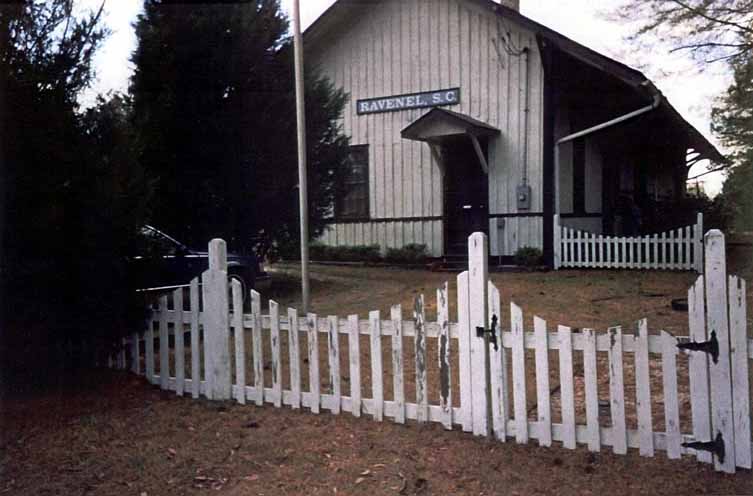
The news article gave Ravenel quite a "splash." The article stated that the depot was built about 1900. Some early history was included and it said there are different dates for when the depot was last used, but after the late 1950's, it was used only on special occasions. Ravenel acquired the depot in the mid 1980's and used it for a while as the Town Hall. The depot is to be moved 30-50 feet off the CSX property. The article included reminiscences of the locals about trains through the town and station operations.
As Ravenel moves forward with their plans to establish a railroad museum in the depot, we of the Charleston Chapter will continue to support their efforts. Plans are underway for our donation of some ACL artifacts for their use in the museum. Included in the artifacts are a teletype machine which was used at the Sy switching tower that was located in the neck area of Charleston where the Seaboard tracks crossed those of Southern Railway and a desktop ticket stamp with the name ACL engraved on the stamp template.
The news article gave Ravenel quite a "splash." The article stated that the depot was built about 1900. Some early history was included and it said there are different dates for when the depot was last used, but after the late 1950's, it was used only on special occasions. Ravenel acquired the depot in the mid 1980's and used it for a while as the Town Hall. The depot is to be moved 30-50 feet off the CSX property. The article included reminiscences of the locals about trains through the town and station operations.
As Ravenel moves forward with their plans to establish a railroad museum in the depot, we of the Charleston Chapter will continue to support their efforts. Plans are underway for our donation of some ACL artifacts for their use in the museum. Included in the artifacts are a teletype machine which was used at the Sy switching tower that was located in the neck area of Charleston where the Seaboard tracks crossed those of Southern Railway and a desktop ticket stamp with the name ACL engraved on the stamp template.
º March 2005
Railroad Career Began and Ended in Control Tower
by Ron Brinsin
Evening Post Staff Reporter
After working at it for over four decades, Perry
Jack Smith is convinced that Railroading is in his blood.
The 66 year old telegraph operator for Atlantic Coastline Railroad retired yesterday. His career spanned 41 years and began where it ended - in a track control tower.
Smith, called "P. J." by his cohorts, attributes his longevity to his working for a good company. "Over the years railroading got in my blood and the reason it got there was that I worked for one of the finest railroad families in the country. I can't think of a single day in the entire 41 years when I didn't enjoy my work."
SMITH HAS spent the last 32 years at the Sy Tower near Bennett Yard in North Charleston. His job as telegraph operator included controlling track traffic from Charleston, north to Florence and south to Savannah.
After all those years you might say I got use to it. Working the third trick allowed me to do the things I really enjoyed in my spare time - piddling around in the garden, fishing, things like that."
A native of Worth County, Georgia, he went to work with ACL in October 1925, after a six-month stint in the Army. His first job was in the control tower at old Magnolia Crossing. "I guess you could say I started at the top and have been there ever since."
WHEN HE became a railroad man steam engines were in vogue. Those old steamers could only pull a tonnage (maximum) of 60 cars. But these new diesel engines can pull 230 or more loaded and they're betting more powerful every day. That's why we have less trains on the tracks than we did 40 years ago.
"In the old days we didn't have radios or teletype. The only way we could communicate with the engineers was by whistle signal and with the dispatcher in Florence, by Morse code telegraph."
He has seen the railroads change their code of ethics concerning wrist watches too. "Only four years ago they began to allow us to wear wrist watches during work," he said, "Too much of a chance to make a mistake with a little watch on your arm as compared to a big pocket watch. That's why you always see a railroad man with a watch and chain in his pocket."
HE DISCOUNTS any ideas about railroad becoming obsolete to the airlines and shipping companies. "We can haul things ships and airplanes couldn't begin to attempt to haul, and as for passenger travel, we're improving everyday."
Smith, who describes himself as ". . . a youth at age 66," shares his Sy Tower perch with two other oldtimers, Nathan Tyler and R. F. Bozeman. Between the three, they have 126 years total ACL service. They say it's an ACL record..
Smith says he's really looking forward to his retirement years. "I got some gardening to do around the house and there's plenty of bass in those Monck's Corner lakes waiting for P. J. to catch em." he said.
The 66 year old telegraph operator for Atlantic Coastline Railroad retired yesterday. His career spanned 41 years and began where it ended - in a track control tower.
Smith, called "P. J." by his cohorts, attributes his longevity to his working for a good company. "Over the years railroading got in my blood and the reason it got there was that I worked for one of the finest railroad families in the country. I can't think of a single day in the entire 41 years when I didn't enjoy my work."
SMITH HAS spent the last 32 years at the Sy Tower near Bennett Yard in North Charleston. His job as telegraph operator included controlling track traffic from Charleston, north to Florence and south to Savannah.
After all those years you might say I got use to it. Working the third trick allowed me to do the things I really enjoyed in my spare time - piddling around in the garden, fishing, things like that."
A native of Worth County, Georgia, he went to work with ACL in October 1925, after a six-month stint in the Army. His first job was in the control tower at old Magnolia Crossing. "I guess you could say I started at the top and have been there ever since."
WHEN HE became a railroad man steam engines were in vogue. Those old steamers could only pull a tonnage (maximum) of 60 cars. But these new diesel engines can pull 230 or more loaded and they're betting more powerful every day. That's why we have less trains on the tracks than we did 40 years ago.
"In the old days we didn't have radios or teletype. The only way we could communicate with the engineers was by whistle signal and with the dispatcher in Florence, by Morse code telegraph."
He has seen the railroads change their code of ethics concerning wrist watches too. "Only four years ago they began to allow us to wear wrist watches during work," he said, "Too much of a chance to make a mistake with a little watch on your arm as compared to a big pocket watch. That's why you always see a railroad man with a watch and chain in his pocket."
HE DISCOUNTS any ideas about railroad becoming obsolete to the airlines and shipping companies. "We can haul things ships and airplanes couldn't begin to attempt to haul, and as for passenger travel, we're improving everyday."
Smith, who describes himself as ". . . a youth at age 66," shares his Sy Tower perch with two other oldtimers, Nathan Tyler and R. F. Bozeman. Between the three, they have 126 years total ACL service. They say it's an ACL record..
Smith says he's really looking forward to his retirement years. "I got some gardening to do around the house and there's plenty of bass in those Monck's Corner lakes waiting for P. J. to catch em." he said.
(reprinted from November 19, 1966 Evening Post article)
Note: The teletype machine shown in the photo is
now located at the Ravenel Station. The machine was donated to the
Town of Ravenel by the Charleston Chapter of the National Railway
Historical Society.
Ravenel Receives Artifacts For Depot Museum
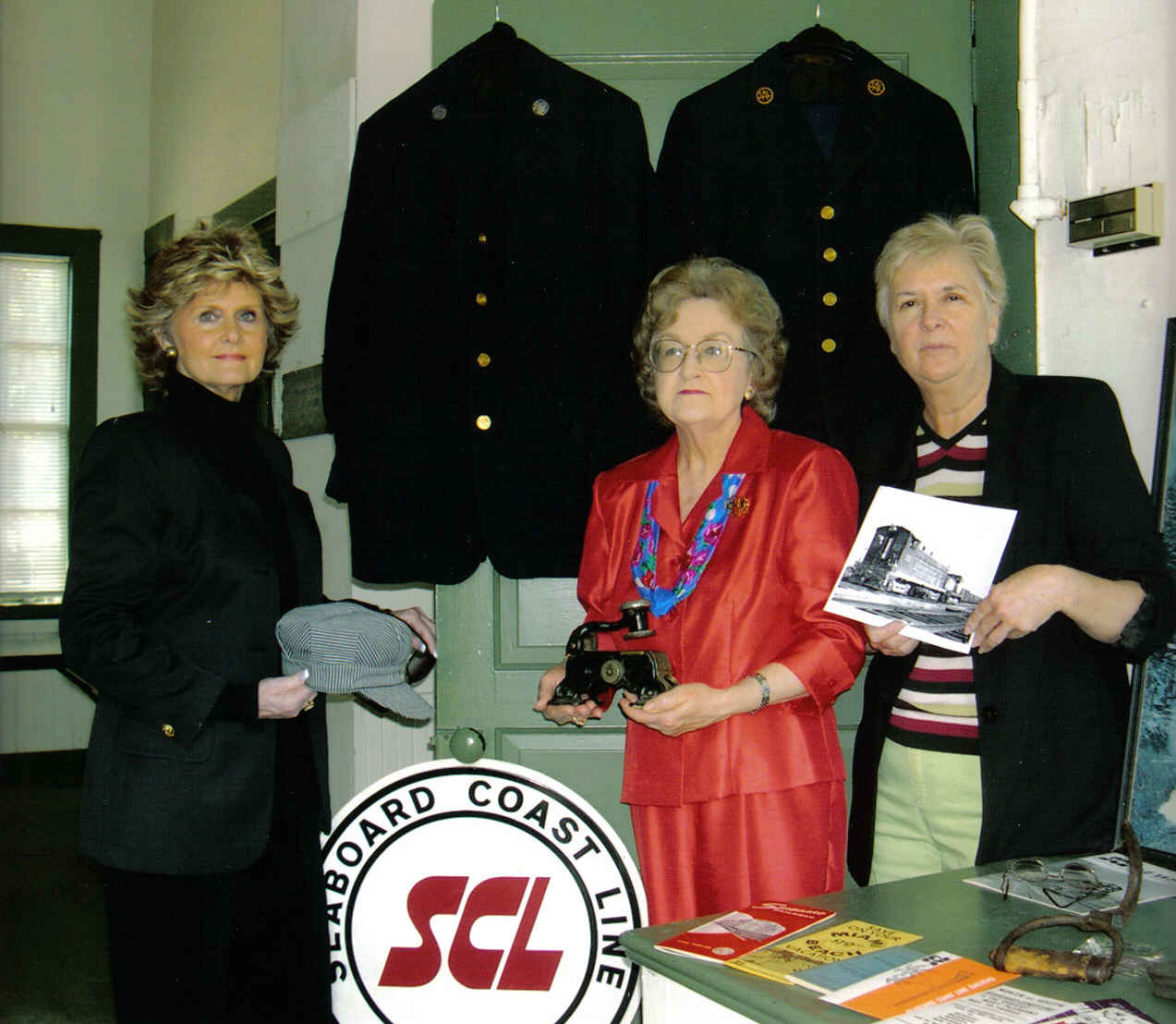 |
On Saturday, May 14, 2005, the Charleston Chapter of the National Railway Historical Society presented various railroad artifacts to the Town of Ravenel for use in their proposed Depot Museum. At a ceremony attended by members of the Charleston Chapter and by local community members, the presentation was made by Mary Lehr, Vice-President of CCNRHS. Mayor Opal Baldwin accepted the donation and spoke of the Town of Ravenel's plans for moving the 2100 square foot depot and creating a museum to honor the railroads which once served the Town and to honor the many railroad workers who live in the Town of Ravenel. Post and Courier reporter, Edward C. Fennell, wrote an article about the artifacts and the presentation. He told of his surprise when Mayor Baldwin showed him the teletype machine, and a piece of grayed paper fell out. It turned out to be instructions on how to use codes for some of the stations. The age of the paper is not known, but the photographed copy below shows that it has been through a lot of wear and tear. The paper is being kept with the machine and there are plans to return the machine to working condition to demonstrate how the machine works. * Photo used with permission of Post and Courier May 2005
|
|
| Mary Lehr, Mayor Baldwin and Sonya Gentry display donated items. |
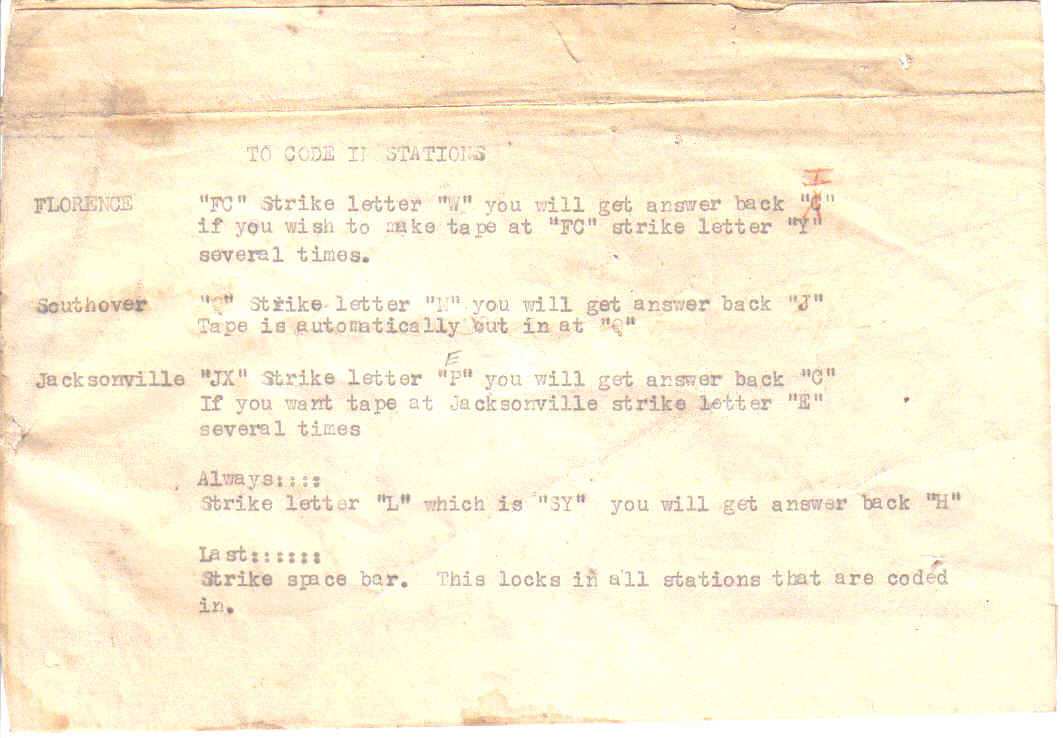 Instructions for using codes on teletype machine.
|